Lubrication and Preservation
By regularly lubricating and preserving your Pilous sawmill, you will extend its service life and ensure high cutting quality.
Proper maintenance of a Pilous sawmill is the absolute foundation of long service life, reliable operation, and cutting precision. If the machine does not receive adequate care in the form of regular lubrication, preservation, and inspection, problems may gradually occur, such as corrosion of metal parts, excessive wear, or unnecessary downtime. For this reason, attention should always be given both to anti-corrosion protection and to systematic lubrication of all moving components.
Anti-Corrosion Protection of the Sawmill
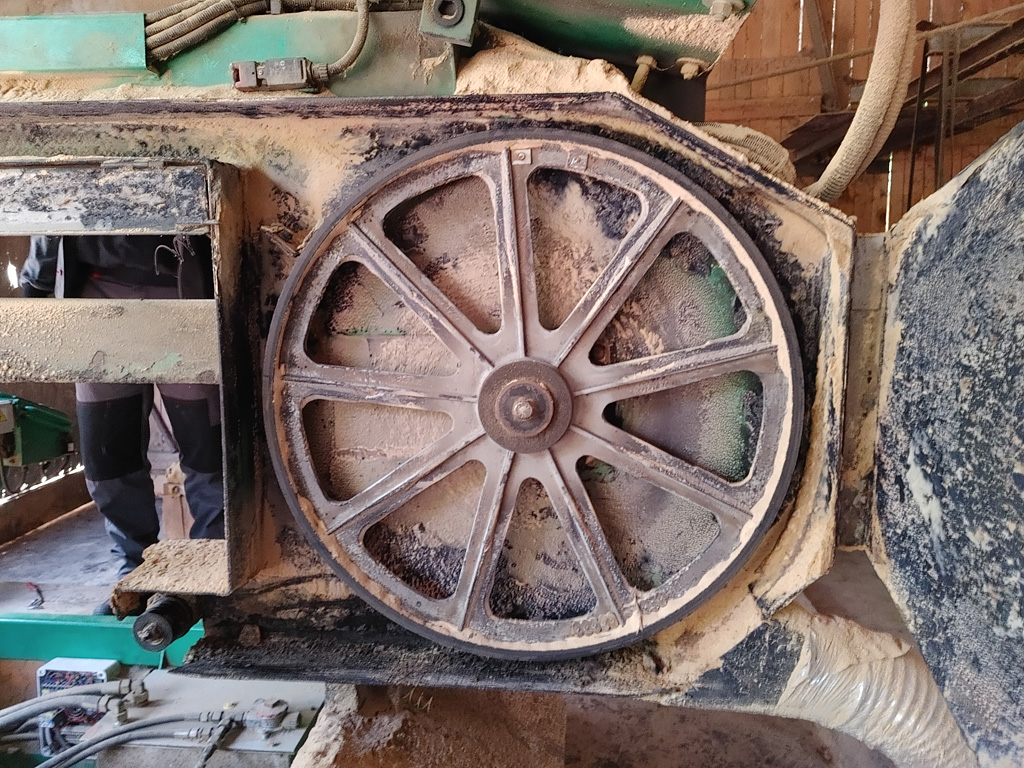
Every machine operates best in an environment where it is protected from rain and snow and functions at temperatures above freezing. Pilous therefore strongly recommends operating all sawmills at least under a shelter. Although machines are treated with high-quality surface protection, such as powder coating or galvanization, none of these technologies can withstand a damp environment over the long term. Very often, machines, particularly those equipped with water cooling for the blade, are left outdoors, not only exposed to rain, but also with wet sawdust left inside the sawmill arm during downtime. Moisture in the wood acts as an electrolyte, accelerating the oxidation process of iron.
When cutting fresh timber, a thin layer of moisture is deposited on the surfaces of metal parts (saw blade, chain, guide bars, rails, bearings, saw arm, etc.), which promotes corrosion. This effect is intensified by organic acids and tannins released from wood, particularly from hardwoods such as oak and beech, which make the environment more aggressive.
In addition, green wood contains dissolved sugars and phenolic compounds that, once dried, form a sticky layer. This layer captures both moisture and dust, encouraging localized corrosion in areas where mechanical cleaning is difficult. Coniferous woods such as spruce or pine are not directly corrosive to metal, but their essential oils and resins damage protective coatings, settle on machine surfaces, and reduce adhesion of anti-corrosion layers. Under normal operating conditions, especially with professional Pilous sawmills, galvanization and powder coatings provide sufficient protection. However, regular maintenance, proper preservation, and protection from excessive moisture remain the most effective ways to keep metal components rust-free and to extend their lifespan.
Lubrication of Pilous Sawmills
Regular maintenance and correct lubrication of a Pilous sawmill are essential steps for smooth operation and long-term reliability. It is important to follow the instructions provided in the operating manual, use only recommended lubricants, and adhere to service intervals. Every three years of operation, we recommend a full service inspection by an authorized Pilous service center, which can professionally assess machine condition and carry out necessary adjustments or repairs. As a general rule, lubrication should be performed at least every forty operating hours to minimize the risk of unnecessary downtime.
Lubrication of Travel Rails
The travel rails of professional Pilous sawmills are not corrosion-protected, and therefore require regular lubrication and cleaning. When putting the machine into operation, we recommend removing all four felt lubricators and immersing them in an oil bath for several minutes to allow proper saturation. During regular operation, it is advisable to replenish them with preservation oil after each shift. When cutting resin-rich woods such as larch or pine, lubrication and cleaning intervals should be halved.
Lubrication of Chains
Chains on sawmills operate in extremely dusty conditions. For this reason, standard chain oil should not be used. Instead, a special dry lubricant (“Dry Lube Oil”) designed for dusty environments is recommended. If standard oil is used, any excess must be wiped off, otherwise sawdust will adhere to the oil film, dry it out, and initiate corrosion.
Lubrication of Bearings
For lubricating bearings, whether guide roller bearings or band wheel bearings, the following rule applies: never fill bearings completely with grease, but only up to one-third to one-half of the free space. If the bearing is filled entirely, it can overheat excessively once the machine is started, sometimes by as much as 50 °C. The high resistance and rotational speed will churn the grease, causing it to degrade, darken, and lose its lubricating properties.
Blade Wheels
Special attention must be given to the seating of the blade wheels, especially tapered roller bearings. These bearings require not only regular lubrication but also play adjustment. The correct procedure is to remove the saw blade, loosen and remove the drive V-belts of the main motor, and then rock the wheel at the six o’clock and twelve o’clock positions. The bearings should show no play. After a few days of machine operation, the bearings may settle, and clearance can appear. In such a case, the bearings must be tightened according to the operating manual, but caution must be taken not to overtighten.
V-Belts
The V-belts of the main drive must be checked within a few days of commissioning the machine. Shortly after initial use, they settle on the pulleys, and their tension loosens. If this step is neglected, the saw-blade may stop directly in the cut. After approximately four years of single-shift operation, we recommend replacing the V-belts to prevent possible complications during work.
Motor
Although it may not be immediately apparent, the main motor of the sawmill also requires attention. Bearing seizure usually very quickly leads to overheating and burning out the motor, which represents significant financial costs and often several days of saw downtime. Motors up to 22 kW have sealed‑for‑life bearings that cannot be re‑lubricated. Manufacturers recommend replacing these bearings after approximately 20,000 hours of operation, which in single‑shift operation corresponds to roughly 10 years. Larger motors over 22 kW are usually equipped with grease nipples for re‑lubricating the bearings. The lubrication interval and the required amount of lubricant are stated on the motor’s nameplate. For more information on motor maintenance we recommend consulting the manuals for the specific motor types. Some can be found HERE.
Pilous Service and Genuine Spare Parts
Although regular maintenance and proper lubrication of a Pilous sawmill are effective ways to extend service life and ensure reliable operation, professional servicing must not be overlooked. Authorized Pilous service centers have both the expertise and genuine spare parts required for maximum machine performance. If needed, please contact us at servis@pilous.cz. Our specialists will be happy to provide advice or schedule a service intervention. With professional care, your Pilous sawmill will operate flawlessly and at maximum efficiency for many years.
This is an example of wet sawdust left in the saw arm overnight - poor machine maintenance.