



Which roller conveyors are suitable for metal band saws?
When selecting a roller conveyor system, it is important to first consider the material to be processed and transported, including its type, shape, length, and weight.
Type of material being transported
For cutting and transporting standard steel materials, roller conveyors equipped with steel rollers are suitable. When cutting stainless steel or aluminum materials (including anodized aluminum), it is necessary to consider whether contact with steel rollers could damage or otherwise affect the surface quality of the material. In such cases, conveyors equipped with plastic rollers are a more suitable option, as they are gentler on sensitive materials.
Roller conveyor width
The width of the roller conveyor should be selected according to the maximum cutting capacity of the band saw at a 90° cut and the width of the workpiece being cut.
Example: The ARG 400 plus S.A.F. band saw has a maximum cutting width of 460 mm at a straight cut. Therefore, the nearest wider conveyor, the L 520 with a conveyor width of 520 mm, should be selected.
Length of the infeed roller conveyor
The length of the infeed roller conveyor should be chosen according to the maximum length of the material to be cut. For safety reasons, the conveyor length should correspond to the longest incoming workpiece. If the workpiece is longer than the standard conveyor section, an extension section should be used.
Example: For a 6 m long workpiece, select 1× L 400 2 m section and 2× KS 400 2 m extension sections.
Length of the outfeed roller conveyor
The length of the outfeed roller conveyor should be selected according to the maximum length of the finished cut workpiece. For safety reasons, the outfeed conveyor should correspond to the maximum length of the finished workpiece or to the required measuring length of an LO or LOD measuring system. If the finished workpiece exceeds the length of the standard section, use an extension section.
Example: For a finished workpiece with a length of 3 m, select 1× L 400 2 m section and 1× LS 400 1 m section.
Roller conveyor load capacity
Roller conveyors should be selected with regard to their maximum load capacity. This value is specified as a static load in kg/m.
When loading material onto the conveyor using a crane or forklift, dynamic loading must also be considered. If material is dropped onto the conveyor, the resulting force may significantly exceed the static load rating.
Our product range includes both non-powered roller conveyors and powered conveyors for easy handling of heavy materials.
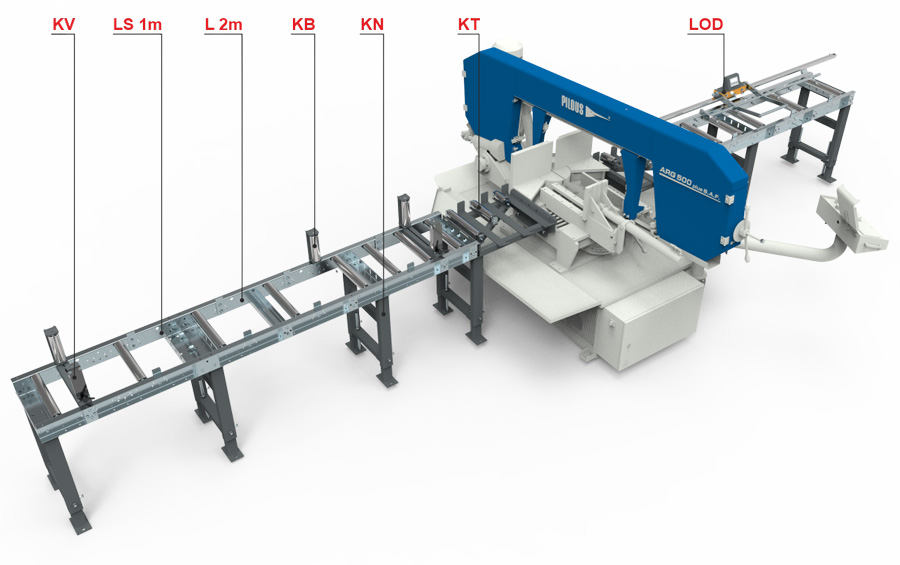
Accessories for roller conveyors
Measuring systems
The most common accessory for outfeed roller conveyors is a measuring system. We offer a wide range of measuring devices, from manual systems through digital readouts to NC measuring systems.
These systems allow fast and precise positioning of the stop at the required length directly from the saw operator's station, significantly reducing handling time compared to manual stop systems.
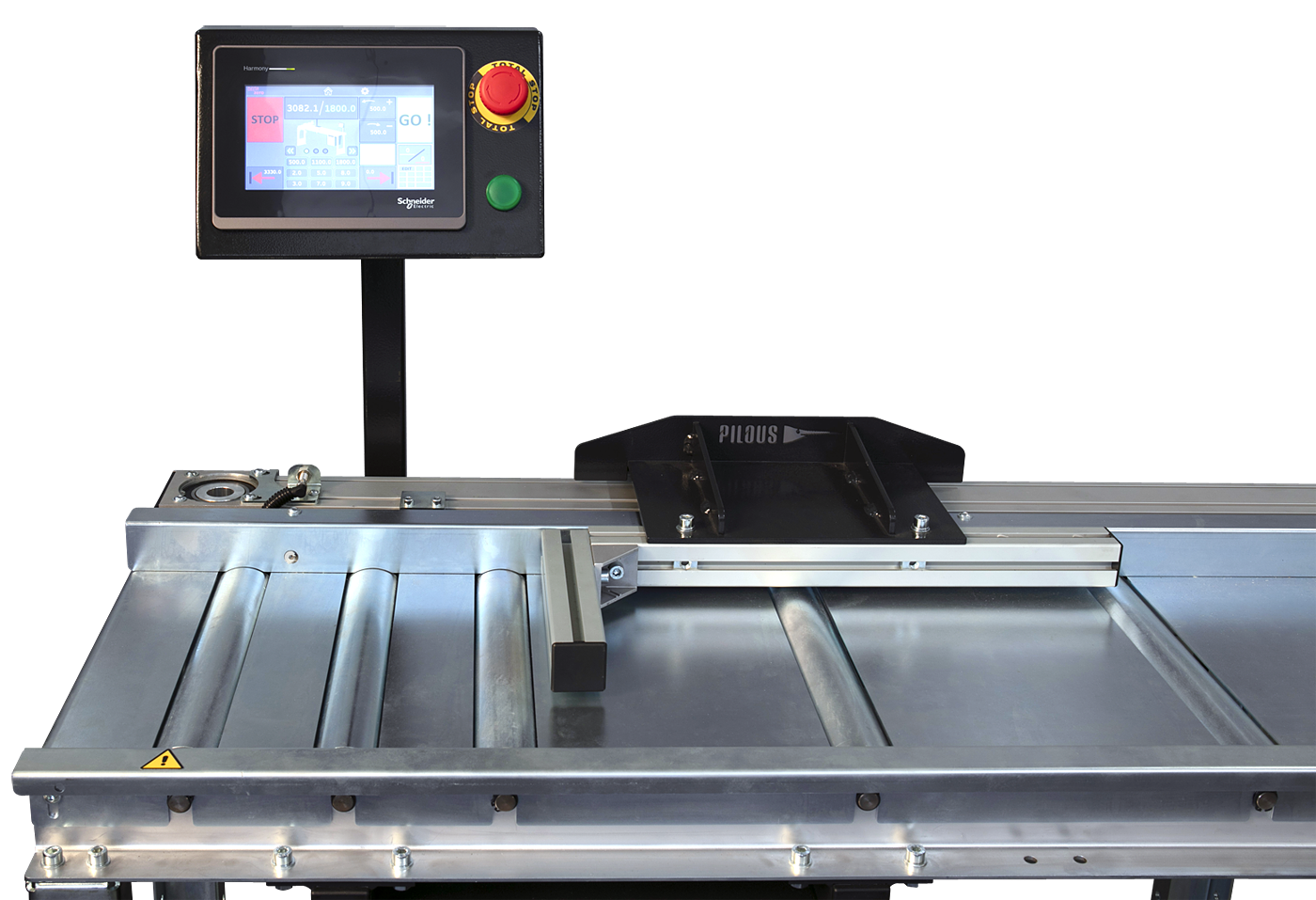
KT connecting adapter
For trouble-free connection of roller conveyors to the saw and to maintain the rigidity of the entire system, the conveyor should be connected to the band saw using the appropriate KT adapter.

KB vertical guide roller
Allows precise guidance of the material between the vise jaws and prevents the material from falling off the conveyor.

KV bracket with adjustable vertical guide roller
An indispensable accessory when cutting bundled material. Available only for conveyors equipped with vertical guide rollers.

KZ lifting roller
The manual eccentric lifting system raises the material above the machine bed, making it easier to move and position.
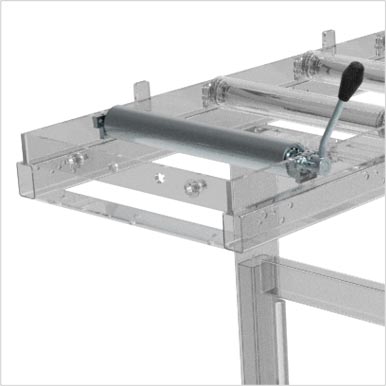
Pilous offers suitable conveyor types, including connection adapters, for every metal band saw, making the selection process significantly easier.