



Why does the band saw blade become wavy when cutting spruce, Douglas fir or larch?
The problem of blade waviness usually occurs when the feed speed into the cut is higher than the band saw blade can handle removing. In other words, the material resistance is higher than what the blade is designed for.
So let us start with a simple, simplified rule that may sound unscientific but is easy to understand:
Wet wood is the easiest to cut, ideally a few days after felling.
A freshly felled healthy tree has varying moisture values (40 to 90 %) that depend mainly on the species and the season when the tree was felled.
You have probably noticed that on large sawmills logs are regularly sprayed with water in the summer months. Logs are sprayed so they do not dry out, crack, increase in hardness and become harder to saw. Wet logs are softer and dimensionally more stable, so they are cut faster, cleaner and with less wear on band saw blades. A log lying in direct sunlight can lose 10 to 20 % moisture at the surface within 24 to 48 hours. A dry surface with a still-wet core creates significant stresses in the wood that later lead to cracks. Cracks downgrade the lumber, which is a problem especially for Douglas fir, larch and oak, but also for other species. Regular spraying makes the log behave like fresh soft wood even when it no longer lies in the forest.
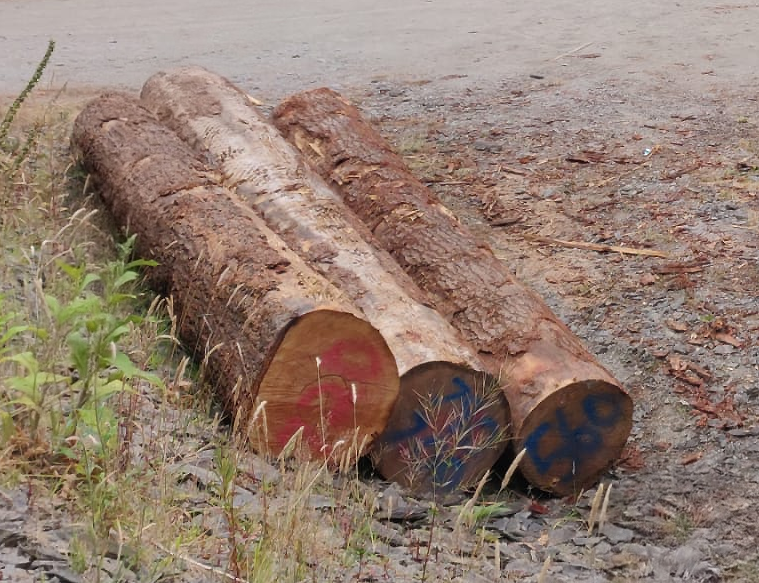
The problem for beginning owners of saw mills is that they often do not know what wood they are actually cutting and what its real moisture content is. They usually buy a band saw blade for softwood without taking into account the condition of the specific logs. Very often a log has been lying in the sun for years, is dried out, or infested by bark beetle. It may also be frozen due to prolonged subzero temperatures. And this is where the most common mistake arises. The sawmill operator thinks they are cutting softwood, but from the blade’s point of view they are cutting material that behaves like hardwood in terms of resistance. Blades 35–60 mm high are particularly prone to waviness due to lower wood moisture.
If we exclude frozen wood, which must be cut with a band saw blade for hardwood (different tooth face angle), the most problematic logs remain those with low moisture. One of the basic indicators that the wood is no longer fresh is peeling bark caused by low surface moisture. If you are not sure of the actual moisture of a log, we recommend using a wood moisture meter. We devoted a separate article to correct moisture measurement and choosing a suitable meter — HERE.
So where is the threshold at which I should use a band saw blade for hardwood even though I am cutting a softwood?
There is no single answer to this question because too many factors influence the result. For interest’s sake — there are many species of spruce, pine and larch in the world. Their density depends not only on the species but also on the conditions in which the particular tree grew. Therefore we recommend gaining your own experience in the conditions in which you usually cut. As guideline values you can use the following recommendations:
-
Spruce, Pine — use a band saw blade for hardwood at moisture below 25 %.
-
Douglas fir — use a band saw blade for hardwood at moisture below 30 %.
-
Larch — use a band saw blade for hardwood at moisture below 35 %.
Thanks to our many years of experience in the manufacture of band saw blades, our technicians will gladly help you choose a suitable band saw blade exactly for your purposes. Contact us — together we will find a technical solution that increases the efficiency of your operation.
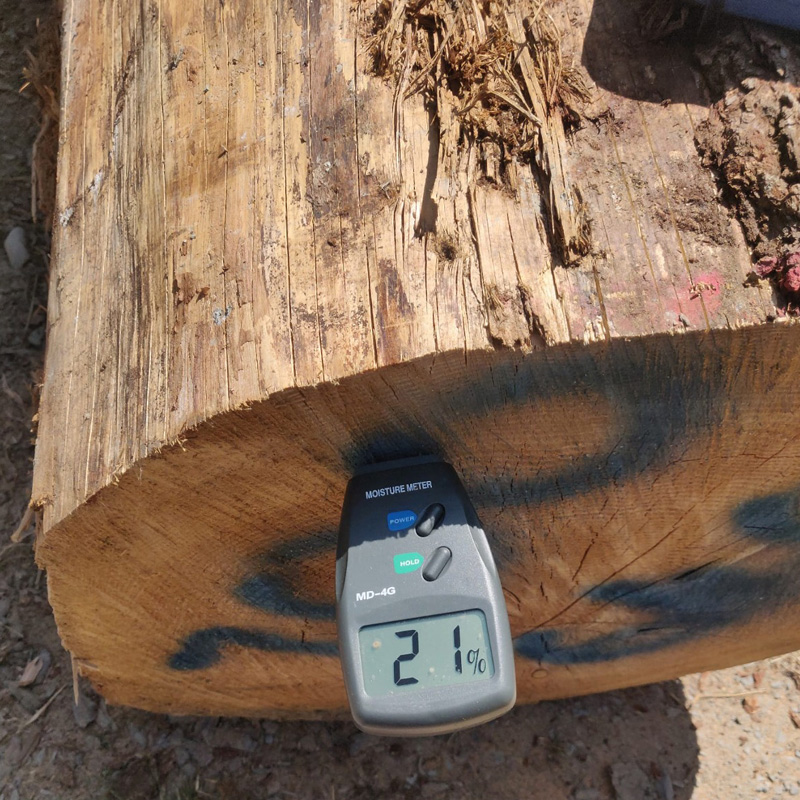
Douglas fir that had been lying unused for a long time. Peeling bark and cracks — indicators that the wood is no longer fresh. Photo from a customer.