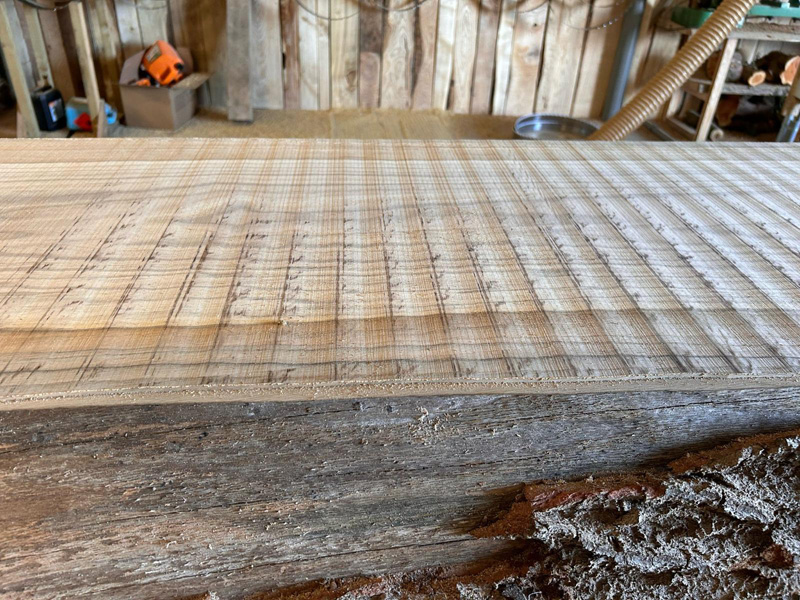
Why does the bandsaw blade wave, the saw vibrate and not feed into the cut when cutting oak, beech, ash or hornbeam?
If the bandsaw blade begins to wave, the sawmill vibrates and does not continue cutting when cutting hardwood, stop work immediately. Vibrations are not normal for a properly functioning bandsaw and can lead to reduced cut quality, damage to the bandsaw blade and the machine itself.
When cutting hardwoods such as oak, beech, ash or hornbeam, you cannot achieve the same performance as when cutting spruce or other softwoods. At the same time, much higher demands are placed on cut quality, because hardwood is more valuable and is usually further processed, so allowances for further machining should be kept as small as possible. A quality woodworking bandsaw, correct machine setup and a suitably chosen bandsaw blade are therefore essential.
The most common cause is an unsuitable bandsaw blade or low wood moisture
Simply put, one rule applies:
Freshly felled wood is the easiest to cut, ideally within a few days after felling.
Fresh healthy oak contains at least around 50% moisture, beech even 64%. Actual moisture varies by species, season and growing conditions.
As wood moisture decreases, cutting resistance increases significantly. It is precisely then that bandsaw blade waviness, reduced directional stability of the cut or the onset of vibrations may occur. This phenomenon most often appears with bandsaw blades 35 to 60 mm in height.
Beware of old or overly dried logs
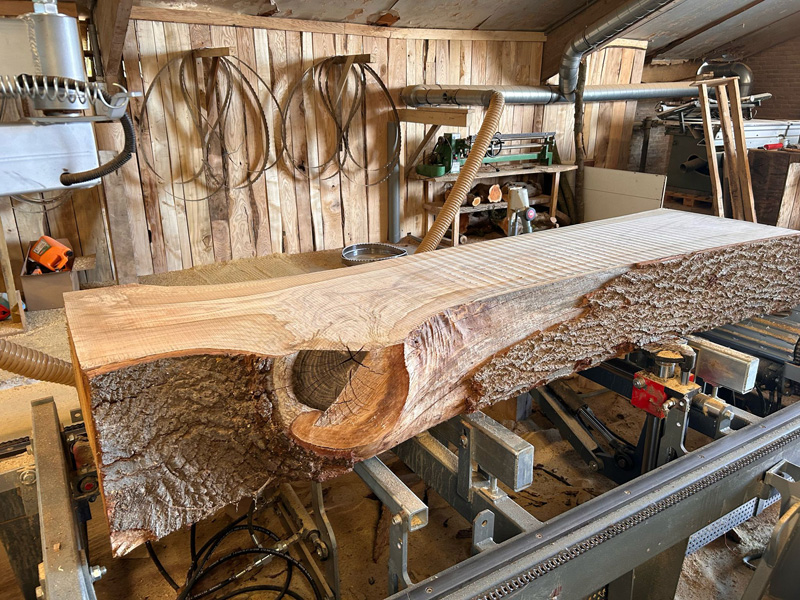
Many novice sawmill owners do not know the true condition of the wood they are cutting. A common mistake is using a standard bandsaw blade for hardwood on a log that has lain in the sun for several years and has significantly dried out. Long‑term frozen wood also presents a similar problem.
The sawmill operator then assumes they are cutting ordinary hardwood. From the bandsaw blade’s point of view, however, this is already a material that requires a blade designed for extremely hard wood. Such a blade differs, for example, in tooth geometry, face angle, tooth set method or may be equipped with a double tooth tip.
How to tell that the wood is no longer fresh?
One of the most reliable signs is peeling bark, which is a consequence of low surface moisture of the trunk. If you are unsure of the actual moisture of the wood, we recommend measuring it with a moisture meter. We devoted a separate article to correct wood moisture measurement and the selection of a suitable meter HERE.
When to choose a bandsaw blade for extremely hard wood?
There is no universal answer to this question. Final cutting behaviour is influenced by species, wood density, the tree’s growing location, season, storage method and the actual moisture of the log.
As a guideline, the following values can be used:
- Oak and ash – we recommend a blade for extremely hard wood at moisture below 20–25%.
- Hornbeam – we recommend at moisture below 22–26%.
- Beech – we recommend at moisture below 18–22%.
These values are indicative. Every operation has different conditions, so we recommend relying primarily on your own experience and long‑term monitoring of cutting results.
Not sure which bandsaw blade to choose?
A correctly chosen bandsaw blade has a decisive impact on cut quality, tool life and the productivity of the entire sawmill. If you are not sure which blade is best for your wood, contact our technicians. With many years of experience in manufacturing sawmills and bandsaw blades, we will help you choose a solution matching the specific wood type and cutting method.
Photo from a customer. An over‑dried log that had lain unused for a long time. Unfortunately, storing bandsaw blades on the wall is also completely wrong, see article HERE.
By supplying special bandsaw blades and changing the storage of bandsaw blades, the problem was solved.